 [Home] [Physics]
[Climate Science] [Election
Science] [Opinion]
[Home] [Physics]
[Climate Science] [Election
Science] [Opinion]
|
|
If you would be a real seeker after truth, you must at least once in your life doubt, as far as possible, all things.
René
DesCartes
Discours de
la Méthode (1637)
Classical Matter is a project devoted to science education. It is intended as a resource for students, educators, and others who are curious about our universe. The general purpose is to de-mystify science, offer sensible explanations of natural phenomena, refute popular myths, and promote evidence-based reasoning. Special emphasis is on the use of classical physical models and methods to explain properties of matter which are elsewhere deemed to be 'non-classical' , or counterintuitive. Topics include special and general relativity, spin 1/2 wave functions, and parity violation. If you want to truly understand how modern physics relates to classical physics, then select Contents to see Resources and Links.
For educational videos, please visit: https://www.youtube.com/user/ClassicalMatter
Selected Publications:
Relativity Model: A stationary particle is modeled as a wave propagating in a circle. The corresponding moving particle has rotated wave crests and propagates along helical paths. This model yields relativistic frequency shift (kinetic energy), time dilation, length contraction, and the deBoglie wavelenth. The model is designed to be printed on a transparency sheet, but can be printed on paper and illuminated with a light shining through the cylindrical tube.
Spin Angular Momentum and the Dirac Equation [R. A. Close, Elect. J. Theor. Phys. 12, 43 (2015)]
Abstract: Quantum mechanical spin angular momentum density, unlike its orbital counterpart,is independent of the choice of origin. A similar classical local angular momentum density maybe defined as the field whose curl is equal to twice the momentum density. Integration by parts shows that this spin density yields the same total angular momentum and kinetic energy as obtained using classical orbital angular momentum. We apply the definition of spin density to a description of elastic waves. Using a simple wave interpretation of Dirac bispinors, we show that Dirac’s equation of evolution for spin density is a special case of our more general equation. Operators for elastic wave energy, momentum, and angular momentum are equivalent to those of relativistic quantum mechanics.
The Wave Basis of Special Relativity, by Robert A. Close (published by Verum Versa, 2014)
An explanation of WHY special relativity works, not just how it works.
For additional publications, visit VerumVersa.com.
Is there an (a)ether?
...we will not be able to do without the aether in theoretical physics, that is, a continuum endowed with physical properties; for general relativity, to whose fundamental viewpoints physicists will always hold fast, rules out direct action at a distance.
Albert Einstein, Concerning the Aether (Über den Äther) 1924
If one examines the question in light of present-day knowledge, one finds that the aether is no longer ruled out by relativity, and good reasons can now be advanced for postulating an aether.
Paul Dirac, in Nature, 1951, vol. 168, pp. 906-907
The modern concept of the vacuum of space, confirmed by everyday experiment, is a relativistic ether. But we do not call it this because it is taboo.
Robert Laughlin, A Different Universe, p.120-121 (2005)
It has also been shown that rotational waves in an isotropic continuous elastic solid can be described within the formalism of the Dirac equation providing a classical interpretation of relativistic quantum mechanics.15
P. A. Deymier, K. Runge, N. Swinteck, and K. Muralidharan in J. Appl. Phys. 115, 163510 (2014)
15R. A. Close, Adv. Appl. Clifford Algebras 21, 273 (2011).
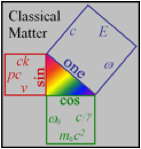
Classical Matter Logo: Did you know that Einstein's famous mass-energy formula E=mc2 is actually a special case of the Pythagorean Theorem? The relativistic 'mass' is actually the rest mass m0 times a factor γ (gamma) which represents the ratio between the hypotenuse and the third side of a right triangle. The hypotenuse is the speed of light (c), the second side is particle velocity (v), and the third side is c/γ =(c2-v2)1/2, which represents speed in directions perpendicular to the average velocity (i.e. wave circulation). The equation can also be written as:

where p=γ m0v is the particle momentum and E is the energy. In terms of wave variables:

with angular frequency ω and wave number k representing wave propagation, and the mass term represents oscillation without propagation (or with propagation in closed loops).
If you would like to add an
educational resource or link, comment on existing resources or links,
or sponsor this site, please contact Robert Close at
robert.close@classicalmatter.org.
This site is hosted by http://www.ipowerweb.com
Exclusive (password required)
Created: February 27, 2006;
Last updated:
Copyright ©
2006-